Draft Coverage — 2009 Recap

Chris Owings – First Round – No. 45 Overall


By Dan Strittmatter


The D-backs continued two of their early trends with their fourth pick of the 2009 draft. First, the team kept their focus on pursuing bats, with Owings, a shortstop, following two third basemen in Bobby Borchering and Matt Davidson, and center fielder A.J. Pollock.


Second, the team aggressively went for higher-upside high school choices; the only one of those four players to come out of college was Pollock, from Notre Dame.


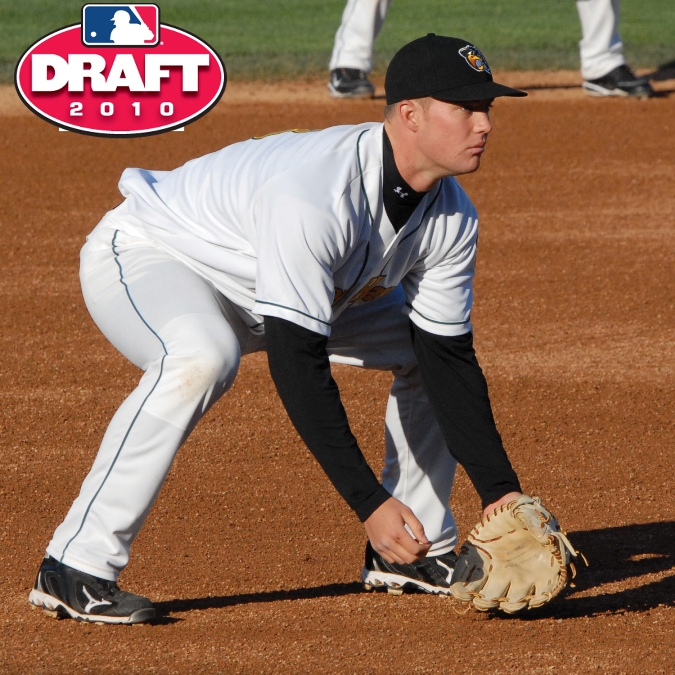
Owings was taken No. 41 overall out of Gilbert High School in Leesville, S.C., and the D-backs had to be aggressive in signing him to convince him to turn pro rather than play in college. Owings projects to hit for a good average with a little pop, and has some speed on the bases as well.


After being signed, Owings pretty accurately fit that scouting report at Rookie-level Missoula in his first experience in pro ball.


For the Osprey’s playoff run late in the summer of 2009, Owings hit .306 with a .426 slugging percentage and three stolen bases (he was not caught stealing) in 24 games. Just three walks in 108 at-bats limited his OBP to .324, and further, Owings was victim to strikeouts quite often, getting rung up 25 times. It also appears that the team intends to give him every chance to succeed at shortstop, much like they’re giving similar chances for Davidson and Borchering to play third base (though many have projected those two as first basemen).


So far in 2010 for Low-A South Bend, Owings has put together a very similar line, with a .288/.308/.414 BA/OBP/SLG line for .722 OPS. Owings’ season hasn’t been flawless, as he still is battling a pretty unsightly K:BB ratio of 39:5. That’s not an uncommon trend for high school draftees in their first full season, though, and if put in proper perspective looks very impressive.


His OPS is substantially higher than the league-average in 2010 for the pitcher-friendly Midwest League, which is just .688. Further, the average age of pitchers in the MWL (as weighted by Baseball-Reference.com) is 21.7 years. Owings, meanwhile, won’t turn 19 until Aug. 12.


For a player to succeed in his age-18 season in a full-season affiliate, the D-backs have to be quite happy with what they’ve seen from Owings.

Draft Coverage — 2009 Recap

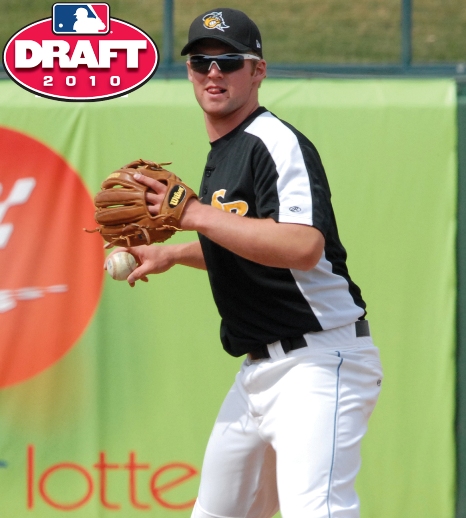
Matt Davidson – First Round – No. 34 overall

Matt Davidson1.jpg

Photo courtesy South Bend Silver Hawks


By Dan Strittmatter


In Matt Davidson, the D-backs have a prospect with tremendous raw power, which was put on display in the summer of 2008 when he won the home run derby prior to the Aflac All-American Game. After being selected, the team sent Davidson to Short-Season Single-A Yakima to get his feet wet, and he had his share of struggles, posting a .631 OPS in 291 plate appearances.


A very successful pitcher early in high school (Davidson hit for himself on days he pitched and DHed on days he didn’t pitch), Davidson had spent just two years at third base prior to being selected, so his defense there is rough and some think because of his size, that he may have to play first base in the Majors. The D-backs are giving him every opportunity to develop at third, though, having him split time at the hot corner with 16th-overall pick Bobby Borchering at Single-A South Bend, where they are both spending their first full-year of professional baseball in 2010.


The offensive numbers have improved dramatically at South Bend this year for Davidson from his stint at Yakima. Davidson is hitting .304 with a .379 OBP and .505 SLG, having hit 16 doubles and seven homers amongst his 56 hits to lead the team in total bases and OPS. There are some concerns, though, beginning with his 54:14 K:BB ratio and high BABIP of .398. However, as his BABIP has started regressing (it was in the upper-.400’s earlier in the season), there has been a coinciding and noticeable improvement in Davidson’s plate discipline and productivity.


In Davidson’s first 25 games, he drew just one walk and struck out 25 times, and averaged 1.42 total bases per hit, with his numbers remaining high due to an unsustainably-high BABIP. But in the 26 games since, he has drawn 13 walks with 29 strikeouts, a respectable 2.23:1 ratio, and his power numbers have also improved dramatically.


In those first 25 games, Davidson had hit just one home run to go with eleven doubles. In the 23 games since, he has one fewer extra-base hit overall, but has six home runs to go with five doubles in ten fewer at-bats, accumulating exactly two total bases per hit and an amazing wOBA of .380. Further, his BABIP in that span has been a more sustainable .309.


Another painful but productive trend in Davidson’s young career is his propensity to get hit by pitches. During his senior season at Yucaipa High School, Davidson was hit by over a dozen pitches, and this has continued into his professional career. So far in 2010, Davidson has been plunked eight times, and these have helped Davidson maintain his fantastic OBP despite his small, but rapidly growing, walk total.


By almost any statistical measure, Matt Davidson has been the most formidable hitter in the Silver Hawks’ lineup in 2010. Should Davidson be promoted this year, his play at South Bend indicates that there’s a strong chance he could compete in the Cal League, especially given its hitter-friendly nature. However, there is a positional logjam at the corner infield positions in Hi-A similar to the one with Davidson and Borchering at South Bend.


It’s an issue, but certainly one that the D-backs are glad to have in their system.


http://vimeo.com/moogaloop.swf?clip_id=12118378&server=vimeo.com&show_title=0&show_byline=0&show_portrait=0&color=8f001a&fullscreen=1

Draft Coverage — 2009 Recap

Bobby Borchering – First Round – No. 16 overall


Bobby Borchering1.jpg

Photo courtesy South Bend Silver Hawks

By Dan Strittmatter


A year ago, Bobby Borchering was a new graduate of Bishop Verot Catholic High School in Fort Meyers, Fla. It’s a safe bet, though, to say that Borchering was alone among his classmates in being compared to Atlanta Braves third baseman Chipper Jones, 1999 NL MVP and six-time All-Star.


Borchering’s power-laden swing from both sides of the plate drew the awe of scouts, many of whom considered Borchering to be the best high school bat on the board in the 2009 draft.


The D-backs took notice, and selected him with their first pick, 16th overall. He showed off his immense power right away for the Rookie-level Missoula Osprey, with eight doubles, a triple and two home runs amongst his 21 hits. But he had some struggles getting on base, hitting .241 and drawing five walks in 93 plate appearances in the regular-season.


However, Borchering had a great postseason for the Osprey, hitting .321 with two home runs and 10 RBI in six postseason games.


The organization assigned Borchering to Single-A South Bend to begin 2010 on a roster filled with other top draft picks from the 2009 draft.


With his first full-season of professional baseball also came some heavy expectations of the 19-year-old first-round pick.


“I try not to worry about that,” Borchering said. “You’ve just got to take it one day at a time and go out there and play your game.”


He got off to a rough start, though, going 1-for-17 in his first five games.


“The biggest adjustment to make is getting used to the environment, especially in South Bend,” Silver Hawks Manager Mark Haley said. “It’s cold, it’s a new environment, you’re going to see some major college kids coming right out of the chute — college guys and older than that, guys with four years in pro ball already.


“He’s not used to that cold weather and making adjustments and seeing that stuff every night, but he’s able to do that. He’s just going to get better and better.”


Since those first five games, Borchering has done just that, posting above-league-average offensive numbers, hitting .267 with eleven doubles and five home runs for a .734 OPS (the 2010 MWL average OPS is .688). This is all the more impressive when you take into consideration that Borchering’s age in a league where the average age of pitchers is more than 21, and that Borchering is in the midst of the longest season of baseball in his career.


“I think the big thing is taking care of your body and making sure you watch what you eat,” Borchering said on how he has dealt with adjusting to the grind of the full-season schedule. “Making sure you cool down after games and go back to normal and get ready to suit up the next day.”


These numbers he has posted since his early-season slump are reminiscent of Justin Upton’s first full season of professional baseball in 2006 for South Bend, also under Haley, when Upton was 18 years old.


Haley said you can indeed draw some comparison between 2006 Upton and 2010 Borchering.


“There are a lot of similarities,” Haley said, “and anytime you get a guy who’s had a lot of success coming up and then is being challenged, how they handle it emotionally is a huge transition.


“That’s why I was very confident that Justin Upton was going to be what he is, and I feel very confident that Bobby Borchering will be (successful).”

http://vimeo.com/moogaloop.swf?clip_id=12117568&server=vimeo.com&show_title=0&show_byline=0&show_portrait=0&color=8f001a&fullscreen=1

Draft Coverage — 2010

draftblue.jpg

For the next week, we’ll be bringing you constant coverage of the D-backs’ 2010 draft, starting with a look at the 2009 draft class.

The D-backs had seven picks in the first two rounds last year, and eight picks out of the top 100.

We’ll give you a look at each of the eight players chosen up in the first three rounds last year, and a glimpse at who some of the sleepers might be in that class.

Next week, we’ll be coming at you live from the D-backs’ draft room, to get a good look at the process that goes into the selections for this year.

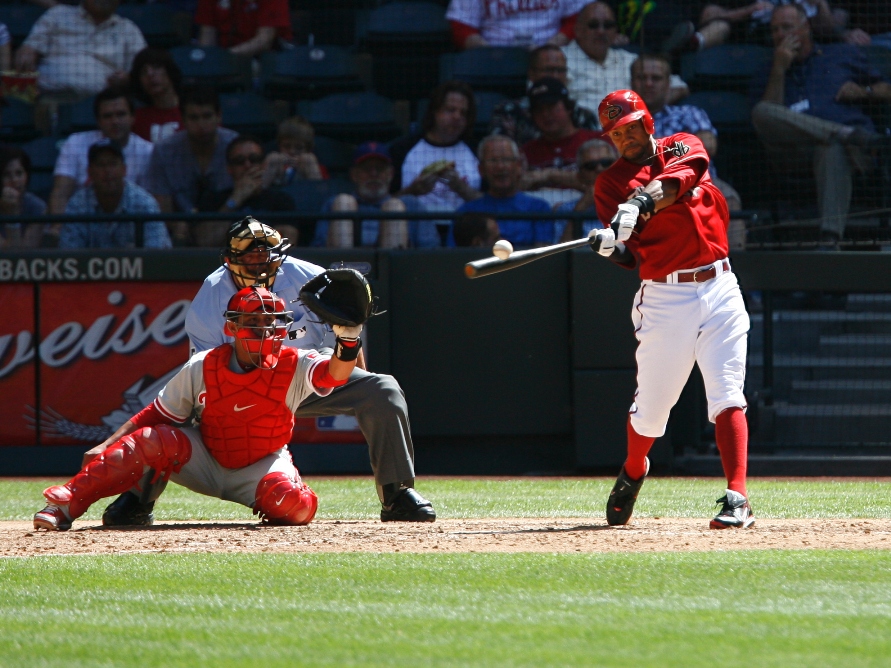
Chris Young v. 2.0(10)

04242010-phi-jw0620.JPG
Photography: Jon Willey

By Dan
Strittmatter


One of
the great disappointments of 2009 was the season of D-backs outfielder Chris
Young. Young slumped for much of the season, culminating in a trip to Triple-A
Reno in early August with a line of .194/.297/.359, for a .655 OPS and .292
wOBA (an explanation of wOBA can be found here).


For
comparison’s sake, the league average OPS in the major leagues in 2009 was
.751, and wOBA is weighted on a scale centered at around .340, with a sub-.300
wOBA being an indication of a “poor” hitter. Further, Young was striking out in
more than 30 percent of his at-bats, compared to rates of around 25 percent in
his previous two seasons.


But,
if you look closely enough, there were signs that Young’s 2009 season was not
full of only negative trends — in fact, Young showed remarkable improvements in
plate discipline.


Swing
Percentage


One of
the most obvious indications of this was his increase in walk rate. In his
first two full seasons in the Major Leagues (min. 500 PAs), Young had walk
rates of 6.9 percent and 8.9 percent. In 2009, lost amidst his struggles was a
significant jump in walk rate to 11.8 percent. This overall improvement can be
broken down in terms of improvements in his O-Swing percentage, the percentage
of pitches outside of the strike zone that Young swung at, and his overall
Swing percentage.


In
those first two seasons, Young swung at 20-23 percent of pitches outside the
strike zone and at 40-43 percent of all pitches he was seeing. But, in 2009,
Young swung at just 18 percent of pitches outside the strike zone, with an
overall swing percentage of 39.5 percent. And these trends have largely
continued into 2010. Young’s O-Swing percentage has risen back up to 20.8
percent, but his overall Swing percentage is at 37.7 percent.


So
what do all of those numbers mean? Basically, Young was an all-around more
disciplined hitter, and was seeing the ball much better. Further, it
demonstrates Young’s willingness to take pitches that he does not feel he can
make solid contact with, either in or out of the strike zone.


These
positive steps have been keys to his hot start in 2010. But this didn’t
translate to success for Young in 2009 because, despite his improved approach,
he was simply missing the pitches that he swung at. His contact rates were
down, and, as we’ll look into next, his swing had some mechanical kinks in it
that masked his improved discipline even when he did make contact.


Batting
Average on Balls in Play


Young’s
BABIP (explained here)
in 2009 was .251, a low number that, at a quick glance, could simply be chalked
up to bad luck. However, looking deeper at Young’s batted-ball distribution,
there are a couple of trends to note. While Young’s line drive rates have not
deviated too dramatically throughout his career, in 2009 Young saw a huge drop
in his groundball percentage, and a spike in his flyball percentage. In 2008,
Young had a 38.0 percent groundball rate, and a 42.8 percent flyball rate. In
2009, Young had a 26.3 percent groundball rate, and a 55.6 percent flyball
rate. Now, in terms of overall offensive production, this is a good thing. Ground-balls
can often also result in double-plays, and an increase in fly-balls can often
result in a corresponding increase in home runs (although, oddly enough, BABIP
on ground balls is also generally higher than BABIP of fly balls). But, of
course, Young did not reap those benefits in 2009.


Infield
Fly Rate


This
leads now to the most significant difference in 2009 and 2010 for Young, and
why Young has had such a good start to 2010. There was one major factor killing
Young’s BABIP, and working against Young’s HR total — his Infield-Fly Rate. In
’07 and ’08, Young had Infield-Fly Rates of 12.7 percent and 16.8 percent. In
2009, Young’s Infield-Fly Rate spiked up to 22.4 percent. So even though Young
was hitting fewer groundballs, the flyballs he was replacing them with were infield-flies, which are almost guaranteed-outs, and which tanked his BABIP and
certainly were not going to help contribute to his HR numbers. So Young’s .32
drop in BABIP from ’08 to ’09 was not a factor of bad luck, but a mechanical
flaw that was causing him to get too far under pitches and popping them up in
the infield at a career-high rate.


Since
his demotion to Reno, Young’s swing has noticeably flattened-out, and he has
seen a career-low Infield-Fly Rate to start 2010, just 11.7 percent. This has
allowed for Young to reap all of the benefits of his improved plate discipline
from 2009. His walk rate has remained high at 10.2 percent and his strikeout
rate is lower than it has been in any of his full seasons in the Major Leagues,
at 23.6 percent. These rates have helped Young post a .364 OBP, his highest
number in the major leagues by 49 points (.315 – 2008). Also, if the season
were to end today, it would mark the first time that Young posted an
above-league-average OBP in his career.


For a
lineup chock full of big power bats in need of base-runners to drive in,
Young’s ability to get on base is all the more important.


As an
end result of this improved approach, Young is on pace for his best season with
a .373 wOBA, and in terms of WAR — Wins Above Replacement (in short, the number
of wins a player contributes to a team over the value of the average player
willing to sign for league-minimum salary, explained in full detail for
pitchers and hitters in the links here)
— having already been worth 1.2 WAR in 43 games. To compare, Young’s best full
season so far was his ’08 campaign, in which he was worth 2.2 WAR in 160 games.


And
with Young’s increasingly flyball oriented hit distribution, it doesn’t appear
as if Young will see a significant drop-off in home run production from his
rookie season, even while abandoning his free-swinging approach.


*All
stats accurate through May 22.
Parker to Throw Bullpen Session Monday

05202010-sf-jw0003.jpg

Nine months after D-backs prospect Jarrod Parker was shut down with an elbow injury and seven months after surgery, the right-hander is scheduled throw a bullpen session Monday.


“I’m going to be on the mound Monday for my first bullpen session,” Parker said. “(Friday) I’ll finish up my long toss and be ready to go Monday on the mound.”


Parker was at Chase Field Thursday to watch the D-backs take on the Giants and pitcher Tim Lincecum.


Parker had Tommy John surgery performed on Oct. 28 by Dr. James Andrews in Birmingham, Ala. Last year, he went a combined 5-6 with a 3.14 ERA in 97 1/3 innings over 20 starts at Single-A Advanced Visalia and Double-A Mobile. In the 16 starts at Double-A, he posted a 3.68 ERA.


He went on the disabled list from June 14-24 with a right wrist contusion, and then on Aug. 17 for the remainder of the season with inflammation of his right elbow. Parker said his recovery has been going well.


“I have no complaints,” he said. “Our medical staff has done everything right.”


These days, Parker is living in Tucson to work out with the medical staff and trainers at the D-backs’ minor league complex.


“I got the rehab protocol laid out,” he said. “Right now it’s kind of day-to-day with how I feel on the mound, but I’m going to bust my butt to be back as quickly as I can. That’s just how I am. But they’re going to want to be slow, with the surgery and the types of things that can happen.”


At this point — especially before Parker pitches in a bullpen session — it’s difficult to put any sort of specific timetable out for his return. However, a full return to health prior to Spring Training is certainly likely, barring any significant setbacks. A return for the Arizona Fall League in October is is something he’d like to try for, at least, but obviously less likely.


“(October) is a realistic goal for this year, but 110 percent in Spring Training is the for-real goal,” Parker said. “But I would love to pitch in the Fall League.”


This is the first real injury Parker has ever had in baseball, so his perspective has been strange. Never before has he had to watch baseball on TV without the opportunity to go play.


“That’s the worst thing, watching games on TV every night,” Parker said. “I go to rehab in the morning and get done at 11 or noon and then I’m watching games every night. I want to be out there. I want to pitch, I want to play. I’m just itching.


“(Rehabilitation) taught me some patience and being more mature. It’s tough but I’m in the best shape of my life, putting on some real solid weight and getting in good shape. It kind of makes you look at the game a different way.”


Kids Work Their Way to Chase Field with Inner City Jam

On Tuesday evening, D-backs fans may have heard a rumble coming down Fourth Street toward Chase Field.


Walking toward the D-backs vs. Dodgers game were several hundred elementary school students from schools throughout the Valley, brought together for the 12th annual Inner City Jam.


Maricopa County Supervisor Mary Rose Wilcox has spearheaded the event since the D-backs’ first season back in 1998. It’s an opportunity to have children who might not normally make it out to a ballgame spend a night rooting on their D-backs.


Kids earn the chance to participate in the Inner City Jam through community service work, including helping out in their schools, neighborhoods and churches.


D-backs broadcasters Miguel Quintana, Oscar Soria and Richard Saenz attend the event annually, and were on hand to help emcee the event on Tuesday. Quintana was especially impressed with the handful of kids who won prize packs — a D-backs bag, a shirt or jersey, a cap and tickets to a D-backs game. One person from each participating school was chosen based on their community involvement that went above and beyond that of their peers.


“I like seeing kids from different schools,” Quintana said. “There are a lot of Hispanic kids who are involved with it, and most of the kids who won the awards went over and above what they were supposed to do.


“They were doing community service, helping neighbors with their yards, helping senior citizens. I think it’s interesting. It shows them that there is a reward for doing something.”


Mostly, Quintana said, the great part of the event is seeing all of the kids in matching D-backs shirts, headed to the ballpark where they can grab a bag of popcorn, scream as loud as they want for the D-backs, and just have fun for a few hours.


The school that made the loudest noise at the event got to lead the group parade to Chase Field.


“I think it’s exciting,” Quintana said. “The main requirement for those kids to be there was to be loud. So I think it’s really great that they get out of the school, come to the park and they can be kids and be loud. I like that idea. And I like the fact that they have to do community service so they can be a part of this group.”

Gillespie Goes Deep

gillespie.JPG

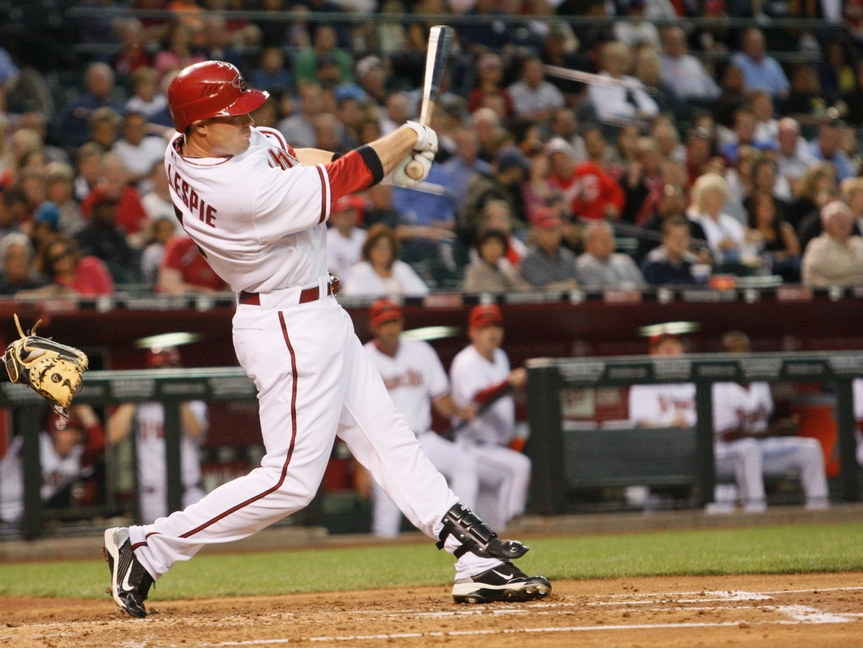
Congratulations to outfielder Cole Gillespie on hitting his first Major League home run tonight.

He took a 1-0 fastball on the outside part of the plate and drove it to right field to tie the game 1-1 here at Chase.

Obviously, Gillespie may not be long for the big leagues, because Conor Jackson is progressing well in his injury rehab (2-for-4 last night with a homer, three runs and two RBI), but Gillespie has certainly impressed some people around Phoenix. His ability to back up all three outfield positions and hit for some power (a .607 slugging percentage in 28 big league at bats) will definitely get him some more at bats in the big leagues this year.


Some notes 

— D-backs shortstops (read: Stephen Drew, who has 116 of the 121 PAs) are third in all of Major League Baseball in OPS, trailing only Florida (Hanley Ramirez, who is likely to stay on top) and Toronto.

— The rest of the positions, rank in OPS out of the 30 MLB teams: Catcher – 5th, First Base – 6th, Second Base – 3rd, Third Base – 6th, Left Field – 23rd, Center Field – 8th, Right Field – 25th, Pitcher – 3rd.

— Reflecting on those: Jackson will certainly be welcomed back to play left, where he should he should produce something like his usual .360/.440 line, and I don’t believe anyone is too worried about Justin Upton getting going in right. But talk about players pulling their weight; to have five positions (six if you count pitchers) producing in the top 10 in the league at their position offensively is quite a team contribution.


D-backs Dig the Long Ball

04252010-PHI-jm0166.JPG

Remember this winter when we discussed the D-backs’ offensive adjustments and the potential improvement?


Well, the D-backs have the best offense in the National League.


Through the games played on Tuesday, the D-backs are leading the NL in runs with 154 (14 13 more than the second-ranked Phillies) [EDIT: whoops, bad math there…], particularly impressive coming on the heels of a 1-0 game. Further, this isn’t a schedule fluke — the D-backs 5.70 runs per game also leads the Senior Circuit.


Another impressive caveat is that much of the talk of offensive improvement was based on full seasons from Miguel Montero and Conor Jackson, neither of whom have been able to contribute much yet.


Here are the ranks in a few big categories:


Runs:


1. D-backs 154
2. Phillies 141
3. Brewers 139
4. Dodgers 137
5. Rockies 133


Runs per game:


1. D-backs 5.70
2. Phillies 5.42
3. Brewers 5.35
4. Dodgers 5.27
5. Marlins 4.96


Home runs:


1. D-backs 40
2. Cubs 34
3. Cardinals 31
4. Brewers 30
5. Phillies 29


Doubles: 


1. D-backs 60
2. Brewers 59
3. Nationals 57
4. Cardinals 57
5. Phillies 56


OPS:


1. D-backs .817
2. Brewers .806
3. Cubs .794
4. Dodgers .785
5. Phillies .777


OPS+ (that’s park-adjusted OPS)


1. Brewers 115
2. Dodgers 111
3. D-backs 107
4. Cardinals 103
5. Phillies 102


And one last one, and you may notice a recurring message on this blog — this is one baseball fan and writer who isn’t very concerned about strikeouts on offense. (Number in parentheses is team’s rank in runs scored.)


Strikeouts:


1. D-backs 246  (1)
2. Padres 224  (9)
3. Marlins 212  (7)
4. Cardinals 210  (8)
5. Rockies 208  (5)


And while we’re here: The three teams who strike out the least on offense — Washington, Houston and San Francisco — happen to rank 13, 15 and 10 in scoring, respectively.


So who’s responsible for this bonanza, and is it sustainable? Well, at the risk of being vague, I suppose those answers are: it’s not entirely clear & we’ll see.


Some credit should go to Hitting Coach Jack Howell, under whom several D-backs hitters improved in 2009. Now with a full year and Spring Training, players have had a chance to fully buy in to the training methods Howell uses.


NL Player of the Month for April, Kelly Johnson, deserves a heap of credit, starting the year with a 166 OPS+. Stephen Drew has very quietly been good — this coming from a player who has been stronger in the second half in his career than in the first — getting on base at a fine .348 clip, and his power is yet to really come along.


Newcomer Adam LaRoche has been better at the outset than, I think, most would have expected, and Chris Snyder has taken the opportunity to get regular playing time and run with it, including hitting an epic blast in Houston on Monday.


Of course, save a thumbs-up for Chris Young. After an incredibly frustrating 2009 season, he burst out of the gate, hitting .301 with a fantastic .366 OBP in his first 26 games.


We’ll see where it goes from here, but armed with this offense, the D-backs are clearly in the thick of things in the West.


Another Legend Gone

It’s funny. I’ve worked in baseball for seven years and every time Vin Scully is in the Chase Field press box or eating in the dining room, I’ve been too nervous to go say hello.


I thought about that a lot yesterday, when we all found out that baseball had lost one of its legends, Ernie Harwell, the wonderful man with the beautiful voice who called Detroit Tigers games for generations. I felt a similar sadness yesterday that I felt when I heard Philadelphia Phillies broadcaster Harry Kalas died last year. They weren’t just broadcasters, they were titans.


Like a lot of people, I became a baseball fan because of the broadcasters. For me, it was Joe Castiglione, who did (and still does after 28 years) Red Sox games on WEEI. When I was little, without a TV in my room and past my bed time, it was Joe’s voice on a small radio underneath the blankets that would talk me to sleep. Or it was riding in a car with my dad, lamenting that Tim Naehring was hurt again or that Tom Brunansky struck out too much, but the whole time, never turning the dial away from Castiglione’s broadcast. For a lot of people, the same ritual has been done with Scully or Jon Miller or Joe Nuxhall or Denny Matthews or Kalas or Harwell. Same small kids, same radios, same rituals, different cities.


Kalas, like Harwell, was one of those people about whom you never heard a bad word. Everyone who ever met them liked them. We included Kalas in a story we wrote in D-backs Insider a couple years ago, and he was more than happy to help. We were writing a feature on Randy Johnson and wondering if perhaps he was the greatest left-handed pitcher of all time. We figured we’d struggle to find anyone who watched Lefty Grove, but could track down people who saw Sandy Koufax, Warren Spahn and Steve Carlton. Kalas was one of those witnesses for us.


One of the people on our staff, Dave, knew Kalas a bit from his time in media relations, and tracked him down when the Phillies were in town. Kalas sat down with our writer before a game to share memories of Steve Carlton and compare him to Johnson. When I saw Harry later that evening, I thanked him and mentioned how much it meant to us to include someone of his stature in our magazine. He couldn’t have been nicer or more gracious with us.


I never did have a chance to meet Ernie Harwell, though I sure wish I could have. I will always remember Harry Kalas and how courteous he was. It’s a real privilege to have these voices on our radios and TVs, and I guess yesterday was a reminder to take notice of that. I suppose I’ll go say hello to Vin Scully the next time I have a chance, because I’ll regret it if I don’t. We are awfully lucky that he’s still on the air.