So How Does Arbitration Work, Anyway?

@Insider_Writer


You may have heard about the deadline tonight for teams to offer arbitration to free-agency eligible players, of which the Arizona Diamondbacks have two. But you may wonder what it is and why it matters (or you may not wonder either of those things, you may not care at all). Hopefully this post will help describe why arbitration exists, why it’s important and why you really should care.


I’ve never worked in a baseball operations department, and I’ve not spent years of my life studying the process and weighing the risk/reward of arbitration the way baseball ops guys have done, so what I can offer you is a dime-store tour of the process.


The D-backs have two players — Adam LaRoche and Aaron Heilman — who are eligible for arbitration, with a deadline of tonight at midnight eastern to make an offer. This is not a contract offer, per se, simply the declaration of the intention to make an offer for an arbitrary hearing that would award a player a one-year contract. The player has the right to refuse arbitration and head to free agency.


There are a few different types of arbitration in the legal world, but simply defined, it’s a process wherein two parties see an independent third party, who then solves a dispute of some kind between the two. The type used for baseball is often called Pendulum Arbitration. Each side, in this case a baseball team and a baseball player, submit a number that is intended to be that player’s one-year salary for the next baseball season. The arbitrator then must choose one side’s number or the other (like a pendulum swinging from left to right) but the arbitrator cannot settle on something in the middle.


After choosing to offer arbitration to a player, if the player accepts, the team and player still have a few months to work out a contract on their own if they so choose. Arbitration hearings are then usually done around Spring Training if they don’t work something out.


So Why Should a Team Offer Arbitration?


Major League Baseball has a compensatory system designed to buffer the blow of a team losing a player to free agency. If a Type A Free Agent (there are tiers of free agency determined by a player’s accumulated time and accomplishments in the Major Leagues) leaves a team, the team then receives a first-round pick and a sandwich pick in the next year’s draft (though top 15 picks are protected… if the Diamondbacks sign a free agent this year, they can’t lose their No. 3 overall pick for doing so).


For example, the Detroit Tigers signed Victor Martinez to a contract on Tuesday. The Tigers had the No. 19 pick in the 2011 draft, so that pick will now go to the Boston Red Sox, who lost Martinez in free agency.


There is some serious benefit to offering arbitration to a player who might leave in free agency, especially if that guy is a Type A free agent. A first-round pick, even one in the bottom half of the round, carries huge value to a team.


Just from picks in the past 10 years, you could build a strong team with prominent players that have been drafted with first round picks or supplemental picks that were awarded to teams losing free agents — Adam Wainwright, Kelly Johnson, David Wright, Nick Swisher, Joe Blanton, Conor Jackson, David Aardsma, Adam Jones, Gio Gonzalez, Huston Street, Jacoby Ellsbury, Colby Rasmus, Clay Buchholz, Ian Kennedy, Daniel Bard, Chris Coghlan, Joba Chamberlain and Ike Davis all fit that description.


One of the very best prospects in baseball, Angels’ outfielder Mike Trout, was a compensatory pick in 2009 after the Angels lost Mark Teixeira to the Yankees. The supplemental-round pick the Angels got for Teixeira was Tyler Skaggs, who is now one of the best prospects in the D-backs’ system after coming here in the Dan Haren trade last July.


The catch is that a team can only receive those draft picks if they offer arbitration to that player and that player rejects arbitration and signs elsewhere. The Rangers and Rays, for example, wouldn’t even blink at the chance to offer arbitration to Cliff Lee and Carl Crawford, respectively, because with the option of signing huge, multi-year deals, there is no risk that those players would consider accepting a one-year arbitration deal.


So Why Shouldn’t You Just Always Offer It, What Are the Risks?


Well, there is the risk that he’ll accept it and, in some cases, that is a bad thing. This is particularly the case with two types of players — aging position players and relief pitchers.


In the case of an aging position player, this is a guy that has put in a lot of service time in the Major Leagues and has accumulated a lot of stats, but might be in the decline phase of his career. In his case, an arbitrator is likely to rule in favor of the higher figure (which is always the player’s submission, obviously). So the team not only risks bringing that player back on an expensive one-year deal, but also there is the risk of bringing him back at all. The team may be ready to move on, but would be stuck with a contract.


Relief pitchers can some value for a team, obviously, but offering arbitration to one involves the risk of the player accepting, and the team bringing him back on a deal that is larger than what they would normally offer in a standard one-year free agent contract.


The decision to offer arbitration is a gamble. Yes, you’d love to have the insurance of a first- or second-round pick if that player leaves in free agency, but if you think that player will accept arbitration and make a great deal of money in doing so, sometimes you’re better off declining the chance.


So Why Do I Care?


Because, as noted above, a team can bring in quite a haul of prospects through supplemental picks.


Back in 2009, the D-backs’ farm system had taken quite a hit, because the majority of the team’s top prospects were either promoted to the Major Leagues or sent away in trades (such as the Dan Haren deal that sent prospects to Oakland in return for the All-Star pitcher).


So the D-backs were in a good position to stock up the farm system. There were a number of free agents on the team that were likely to get more money in the open market than they would get on an arbitration deal, so the team offers arbitration.


That year, the D-backs lost Orlando Hudson, Juan Cruz and Brandon Lyon to free agency. But in losing them, the team got the draft picks that they used to select A.J. Pollock, Matt Davidson, Chris Owings, Mike Belfiore and Eric Smith. Today, those players are five of the top prospects in the organization.


So What Happens Now?


The D-backs will choose whether to offer arbitration to LaRoche and Heilman. If they offer to one or both of those guys, and the player(s) accept, then the D-backs will work out a one-year deal with the player. If they offer and the player rejects, the D-backs will receive draft picks when another club signs those guys. If they choose not to offer, the D-backs will receive no draft pick compensation in return for the player leaving, but will also not carry the risk of signing a player they might not have been planning on bringing back in 2011.


So offering arbitration or not to a player might seem like a small news story in November, but the decision has wide-ranging effects on the organization for years to come.
D-backs Deal S. Allen to Yankees for 1B Miranda


99971974.jpg

Photo by Chris Trotman/Getty Images

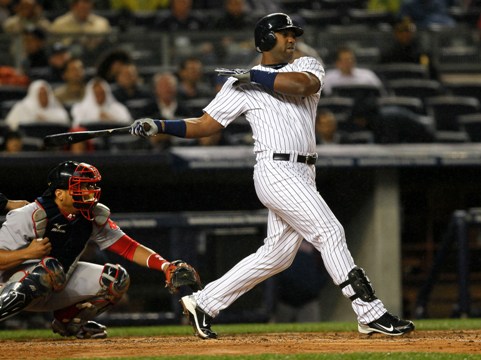
While rumors swirled about big trades in the works, the D-backs made a less notable move Thursday, dealing minor league pitcher Scottie Allen to the New York Yankees for first baseman Juan Miranda.


Miranda, a native of Cuba, signed with the Yankees as an amateur free agent in 2006. He debuted in American pro ball in 2007, splitting games between high-A Tampa and Double-A Trenton. He has spent parts of the last three seasons in the Major Leagues — including 33 games with the Yankees in 2010 — while playing the majority of his games at Triple-A Scranton/Wilkes Barre.


In 423 minor league games, Miranda posted a .281/.367/.478 line, hitting 62 homers 195 walks and 357 strikeouts.


Allen was an 11th round pick of the D-backs in the 2009 Draft and spent the 2010 season as part of a pretty solid South Bend rotation. There, he started 16 games with a 4.73 ERA in 78 innings, with 79 strikeouts and 22 walks. Allen did not crack Kevin Goldstein’s top 20 D-backs prospects on the recently released Baseball Prospectus list.


One thing the D-backs have a lot of in their system is mid-level right-handed pitching, and first basemen are another thing they have in spades. So this is a surplus-for-surplus trade from the D-backs perspective, with the local team receiving the guy who could play in the big leagues today if need be.

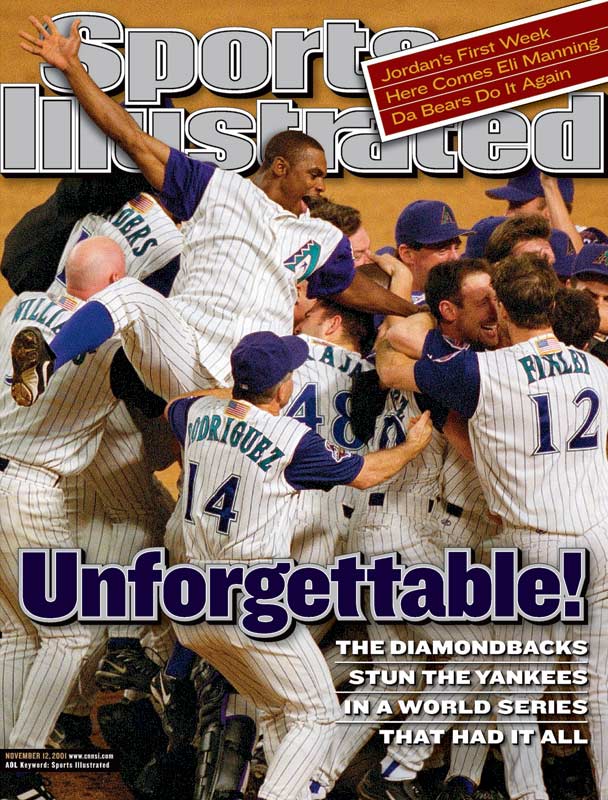
This Day in History: D-backs win World Series

2001-world-series.jpg

In what is indisputably considered to be one of the most exciting World Series ever played, the Arizona Diamondbacks defeated the New York Yankees nine years ago today to bring our state its first major professional championship.

Curt Schilling went pitch-for-pitch with Roger Clemens in a spectacular Game 7, which was topped off by Randy Johnson pitching brilliantly out of the bullpen, and Luis Gonzalez knocking in the series-winning run on a blooper to left-center field.

We all have our distinct, personal memories of that great night, and please feel free to share yours in the comments section.

Here is Tom Verducci’s great cover story that ran in the Sports Illustrated that featured the cover above.


Collmenter Succeeding in Fall League

Collmenter 2.JPG

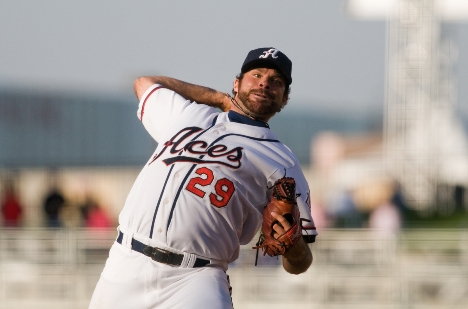
Josh Collmenter is playing for his fourth different team in 2010, at four different levels.


The tall right-hander played for the Visalia Rawhide of the Class-A Advanced California League, the Double-A Mobile Bay Bears and the Triple-A Reno Aces. Now, the starter with the funky delivery is doing his thing for the Scottsdale Scorpions in the Arizona Fall League, and he’s doing it well.


Through three starts for the Scorpions, Collmenter has a stellar 1.80 ERA over 10 innings, with six strikeouts. Among starters with at least 10 innings so far, only two pitchers have an ERA better than Collmenter’s.


“I’m happy with everything,” he said of his results so far. “I really didn’t know what to expect, going against stacked lineups. But I’m just trying to execute and not change anything I’ve done all year. (Success) helps build the confidence.”


With his minor league track record in 2010 — a 3.38 ERA with 133 punchouts in 152 innings, 137 of which were at Mobile and Reno — coupled with likely significant changes at the Major League level, an appearance on the big league team in 2011 is a realistic goal for Collmenter at some point, if not at the outset of the season. It’s an impressive opportunity for a guy who was drafted in the 15th round only three years ago.


“We’ve got a lot of guys coming in, new guys, and they’re going to be doing who knows what with the organization,” Collmenter said. “I know there are going to be opportunities and a lot of holes to fill, so hopefully (I’ll advance), that’s the goal.”


His weapon is his changeup, and it drew rave reviews from former Mobile teammates Barry Enright and Konrad Schmidt. Collmenter has had success locating the pitch where he needs it, and his unique delivery (which involves holding his right hand behind his head for longer than a pitcher would generally keep it there) makes it difficult for a batter to pick it up.


“The biggest key last year was being able to throw it for strikes and really use it,” Collmenter said. “The changeup is the pitch that really got me where I am in my development, level to level. I’ve been able to hone that and make it do different things if I want to get a strikeout or if I want to get a groundball. The biggest key for me is being able to throw the changeup any time.


“My repertoire has been the same, pretty much since college. So I’m just fine-tuning that. It’s pretty much just changing up how I use it and when I use it. I’m working on throwing strikes with my off-speed pitches. I’m not going to throw the ball by guys, so I try to keep them off balance.”


Even more than the chance to pitch, the Fall League offers players the chance to get to know teammates inside the organization that they may not have played with before, or opposing players who they’ve played against but haven’t gotten to know previously.


“It’s been fun, being around different guys that you don’t get to play with or talk to during the season,” Collmenter said. “There are guys that you recognize and it’s cool to branch out and get to know everybody. It’s really laid back and the competition, you can’t beat it.”


D-backs Notes:

— Outfielder Marc Krauss started for the Scorpions in left field on Thursday, going 1-for-4 with a double. Last Friday, Krauss had highlight-reel night, driving in seven runs with a double and a grand slam in a 12-4 win for Scottsdale over the Peoria Javelinas. More than anything, it will be fascinating to watch Krauss’ development over the next few weeks in the AFL, as many of the pitchers in the league come from more advanced levels than him.


— Outfielder A.J. Pollock has been terrific for the Scorpions so far. His .387 average is second among Scottsdale players, and he’s hit four doubles with seven RBI in eight games. Pollock didn’t play all year after suffering an elbow injury in Spring Training, so it’s great to see him off to such a hot start here.


— Pitcher Bryan Shaw hasn’t allowed a run yet in AFL play, throwing six shutout innings with four hits and two walks allowed. Shaw spent the season starting at Double-A (4.26 ERA in 33 starts), so his development will be interesting to keep an eye on.

Gibson To Auction 1988 Memorabilia

1988-kirk-gibson(heinz).jpg

Photography: Heinz Kluetmeier/SI


Kirk Gibson was a Tiger and a Dodger and a Royal and a Pirate in his 16-year career, but he’s a Diamondback now. And as he settles in as the manager of this team, he’s moving on from his past.


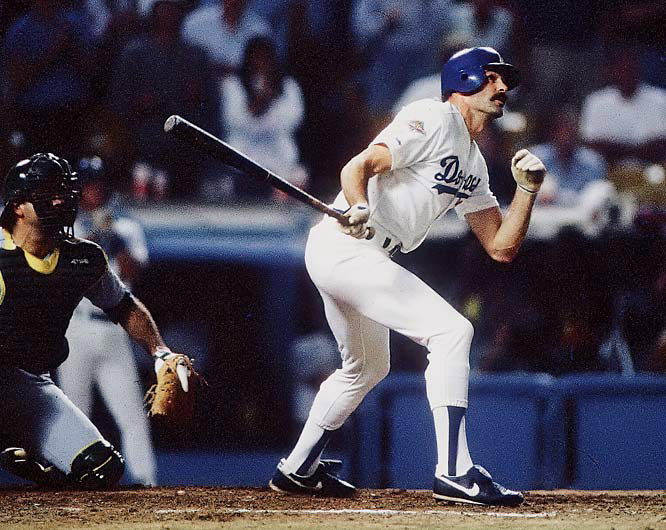
Beginning Oct. 27 through Nov. 13, Gibson will auction the jersey he wore during Game 1 of the 1988 World Series, along with his road uniform from that series, as well as the bat and batting gloves he used to hit his iconic home run off Oakland closer Dennis Eckersley. Gibson is also selling the World Series Trophy and MVP Award he won in 1988, and the proceeds form those two pieces will go to the Kirk Gibson Foundation.


Gibson has been involved philanthropically for years, establishing scholarship funds at the schools where his parents were teachers. He has also help his alma mater, Michigan State University, to build facilities for student athletes.


In the past, I’ve raised probably $15 million for the university,” Gibson said. We built the student-athlete academic center and it’s just outstanding. I’ve given to many, many causes and a lot of athletes do that and this is why I want to continue to build that as long as I’m here.


I’m going to take a portion of the money that is raised and, based upon some of the items I’ve donated out of my foundation specifically, a certain amount of the money from the auction will go there.


The main message for Gibson regarding this auction is the same message he delivered to D-backs players this year, as he encouraged them to actively look for ways to give back to the community.


I’ve been a giver my whole life,” Gibson said. My parents taught me not to be a taker and this is just a mechanism for me to continue giving. It’s all for good reasons. It’s helping people. It’s helping children. I really don’t like takers and it’s my way of promoting giving and I hope to influence many other people that want to do the same.


Gibson had his 1988 memorabilia locked away in storage in Michigan, but decided it was time to move on.


I think many athletes wait until they’re gone and they let their children sort it out and that’s just something my wife and I decided we weren’t going to do,” Gibson said. We’re going to take care of that right now, so a bit of estate planning, too. You could say it that way. It’s time. I don’t know how long I’ll be around here. I’m going to take a bit of the proceeds and do something that I’m going to enjoy, too, while I’m still alive.


Some of the most interesting information Gibson revealed about the auction items was regarding the bat he used to hit the famous Game 1 homer. It wasn’t a bat he used during the regular season. There’s a lot to explain here, so let’s just let Gibson take it away:


The bat thing is pretty interesting. When you’re a major leaguer you get bats usually they come in dozens. That year I was using Worth bats and I always used 35 inch, 33-35 ounce. I never really liked lighter bats because they always felt too light in my hand. The other thing is I would experiment from time to time, like I’d try a 34-½ inch bat, but that always felt too short for me, so I really pretty much always stayed to the 33/35. When you get bats what you do is they weigh every one, then you go through and personally pick them up. You can look at the wood, you like the grain, like the wood. Do you like the balance and how they feel? Out of a dozen bats, maybe four, possibly five bats are what you consider gamer bats. So you take those bats and use them in (batting practice) a couple times and then you take those to the game.


Well, this particular bat, it was a reject, so I basically had it sitting there all year and if you look on the end of the bat , they put my number on the end and there was an X on there, which signified that bat was a 34-½ inch bat and it was too light for me. It was like a 30-31ounce bat so I just Xed it out. As I went through the year I started getting tired and struggled bad in September and when we went to the playoffs I got hurt, I had no legs at all, so I didn’t want to be swinging any big lumber. So I started to get this bat ready in the playoffs and I used it in BP. I used it in the Mets series and had some pretty good success with it in the Mets series.


So, when I got it and we took BP in the World Series, you feel the balance, it felt light, so what I did with it was put a lot of tar on the handle part and the middle of the bat. That way it made it feel a little heavier to me, and if you look at that bat you’ll see there’s a lot of tar on that bat. So it kind of just made the balance feel better, made it feel a little heavier but it wasn’t all in the head of the bat so it wouldn’t make it feel like it was head-heavy. You don’t want that, you want to be able to throw it and you want to have whip.


I ended up using that bat and if you look at the end of that bat No. 23 and you will see an X. If you look at all the tar on there it’s more than normal. If you look at the actual barrel of the bat you’ll see some red marks on there which was the foul balls that I hit. There was red ink on the World Series balls. Where I hit the actual home run you can see on the head, on the sweet spot of the bat, is actually chipped out of there. There is a little nick where I hit it. But then if you look on the backside of the barrel, the part where you didn’t hit the ball, it’s really cool because you’ll see all these nicks and that’s from me hitting my cleats. And if you watch the film you see me hitting my cleats. At the beginning of the bat, they weren’t very deep. Then as the at-bat progressed, I kept hitting it harder and harder. When it got 3-2 they’re really deep. So when you look at the bat, the whole bat has so much character. Everything about that bat, it’s like a painting, it’s like a story and it will tell you the whole thing.”

Pitching Trio Happy With Performances

Brandon Webb, Jarrod Parker and Tyler Skaggs could not be further apart along a spectrum of experience in pitching, but the three of them took the mound of the first innings of the D-backs Instructional League game against the Rockies squad at Chase Field Thursday.


The three all pitched under somewhat different circumstances, but all felt good about their performances.


Brandon Webb threw the first two innings, as he continues his rehabilitation from a shoulder surgery that cost him the entire 2010 season and all but one start in 2009; the last time he pitched at Chase Field was against the Rockies’ big league team on Opening Day of 2009. Webb said the start felt the way they always do, with the exception of the team’s location — the D-backs team was in the first base dugout, rather than their customary spot in the third base dugout.


“It felt good,” Webb said. “It was a little bit different warming up in the visitor’s bullpen, but other than that it felt good. It kind of went the way that it has been in bullpens and sim games and stuff like that. In the second inning, I ended up feeling better, even though I gave up a couple of runs. It felt like I was a little tired, but it was good.


“The best part about it was just being out there and being back on the mound competing.”


Parker followed with two innings of his own, including blowing away the first batter he faced with a strikeout. He lost his 2010 season to Tommy John Surgery, replacing a damaged ulnar collateral ligament in his right elbow. His fastball velocity was mid-90s and his delivery looked strong.


“I feel like I’m close to being back,” Parker said. “My delivery is a little cleaner now and the ball feels good coming out. I’m more consistent with my off-speed than I have been in the past.


“I’m finishing (the mechanics) a little bit more, getting a little more out of my body and shoulder, taking some stress off of my elbow.”


The game was the first at Chase Field in Parker’s career. It was also the first time since surgery he’s pitched to anyone that wasn’t wearing a D-backs uniform.


“It was fun,” he said. “Once they told me (about the game at Chase Field) I was really anxious. I just had to keep it under control. I had a blast getting out there and facing the Rockies.”


Chase Field is a realistic destination for Parker in 2011, assuming rehabilitation continues to go well. He’ll finish out his throwing program which is almost over, then head home to Indiana for the holidays. After that, he’ll report back to D-backs camp prepared to start the season.


He pitched 78 innings at Double-A Mobile in 2009, so there’s a chance he could start at either Mobile or Triple-A Reno to begin the year.


Skaggs isn’t rehabbing from an injury, but he is new to the organization since arriving as the Player to be Named Later in the deal that sent Dan Haren to the Los Angeles Angels of Anaheim. This was a first look at Skaggs for some people with the D-backs. The tall lefty allowed a baserunner, but then quickly induced a double play to end his inning.


“Everything felt good. Curveball, changeup felt good,” Skaggs said. “Everything felt pretty fluid. My fastball and curveball are good but I really need to work on pitching instead of just throwing.”


It was the first time Skaggs had ever pitched in a big league stadium, and while he is considerably farther away from the Major Leagues than Parker, he also was able to use it as motivation to make it back to Phoenix.


“It was pretty exciting. It’s a very big stadium, my first time pitching in a big league stadium. It felt really good.”


I hope to have some video to post tomorrow for the three pitchers working. Check back here for more.

D-backs Retain Gibson, Dipoto


Since Kevin Towers was named General Manager of the Arizona Diamondbacks a little less than two weeks ago, he’s been quite clear about his desire to build a winning philosophy immediately. Those changes begin at the executive level and the coaching level, bringing in people who can create an atmosphere of high expectations.


The steps toward building that culture in 2011 began Monday, when the D-backs announced that Kirk Gibson was retained as Manager on a full-time basis, and Jerry Dipoto — who was a finalist alongside Towers for the G.M. job after serving as interim G.M. — is being retained as Senior Vice President, Scouting & Player Development.


Addressing the move to take the interim label off Gibson’s title, Towers referenced the similar philosophy the two of them share in building a ballclub, particularly citing Gibson’s history as being a winning player.


“Sometimes (the decision is about) gut intuition on people,” Towers said. “I’ve always felt that’s one of my greatest strengths, being able to know people and in a short period of time, knowing who I want to align myself with and who I don’t. I will say, I did my due diligence of talking to external people — coaches, managers, friends — to find out what really makes (Gibson) tick. This man right here is not going to take anything less than winning. I’ve got a lot of admiration for him, I think we’ve kind of hit it off and I’m ready to go to battle with him.”


The D-backs were 34-49 under the tenure of Gibson as interim Manager, but showed significant signs of moving in the right direction even in that short time. The club swept the San Diego Padres in a three-game series at Chase Field Aug. 30-Sept. 1. The Padres then went on to lose the N.L. West division title by one game. The D-backs also swept the Colorado Rockies in three games Sept. 21-23, as the Rockies began to spiral out, losing 13 of their last 14 games to knock themselves out of the race.


Gibson also talked philosophy, particularly pushing the D-backs to become a more aggressive club.


“When you pressure your opponent, when they lose their composure, they make mistakes and that’s how you get into big innings,” Gibson said. “On the other side, when they’re pressuring us, when things aren’t going well, we can’t self-destruct. We have to keep our composure and be able to cut it off and give ourselves an opportunity.”


While Gibson stressed aggression with the team to some degree in his three months as skipper, he plans to use the offseason and Spring Training to fully implement his plans. Among the first will be the way the team practices, which will be at full speed almost immediately.


“We’ll have simulated situations (in Spring Training),” Gibson said. “I’ve written down all of the good and all of the bad in every game that I have managed so far. We’ll recreate every one of those situations. It will be live. We’ve done a lot of practicing in the past at half-speed, quarter-speed. That’s great for the first couple of times, but when we get in shape, we’re going to practice at full go. That’s how it happens on the diamond. We’ll practice all of these plays that we didn’t execute and we’ll be better prepared to handle pressure much better, and we’ll be better prepared to pressure others.


“We’re not going to fall into ‘This is what we are.’ We’re going to be unpredictable and we’re going to do whatever we have to do to hold on and either make something happen or stop something from happening.”


Dipoto made some key changes to the organization in his three months as well, notably acquiring a package that included Joe Saunders and a pair of premier left-handed pitching prospects for Dan Haren, and acquiring Daniel Hudson from the White Sox in exchange for Edwin Jackson. Hudson was nothing short of brilliant, going 7-1 in 11 starts with a 1.69 ERA. He struck out 70 batters while walking just 16 in 79 2/3 innings. For comparison, that strikeout-to-walk ratio (4.38) if spread over a full season, would have been second best in the National League behind Philadelphia ace Roy Halladay.


Dipoto decided that the opportunity to help build a winner in Arizona was the most appealing option for him this offseason, and said he looks forward to helping Towers get there.


“I know grassroots baseball, I know going out and scouting players, I know finding them, I know putting them in a position to succeed,” Dipoto said. “The job description that has been handed to me is such that now I get to go expand the boundaries on the things that I know I’m good at, and why not get better at the things you’re good at? I’m really excited about what the future holds.”


That future — perhaps as soon as 2011 — should include the promotion of a group of excellent prospects in the D-backs’ farm system.


“We have a lot of prospects that have gathered up at the A-levels and we feel this is an opportunity for the organization to see some forward growth in short order,” Dipoto said. “What you were looking back on in 2010, at two or three years on the horizon of these players being in Phoenix, now we’re going to look and they’ll be at Double-A or High-A. We know, as baseball people, those who are at Double-A are a snap away. They can be here any moment. It’s an exciting time to be in the organization and I think we’ve done a good job particularly in the last few months of starting to mold that. I’d be crazy if I didn’t want to stay.”


The D-backs also announced Monday that First base coach Matt Williams and bullpen coach Glenn Sherlock have been retained for 2011. Third base coach Joel Youngblood accepted a position in the organization’s minor league system while pitching coach Mel Stottlemyre, Jr. was offered the opportunity to stay in the organization in a different capacity. Hitting coach Jack Howell and bench coach Bo Porter were not retained.


D-backs Blacked out on DISH Network

Fox and DISH Network failed to reach a deal by midnight that would have kept Fox channels from being suspended on DISH. Thus, Fox channels — including FOX Sports Arizona — will be blacked out until the issue is resolved. From the New York Times:

The subscribers are caught in the middle of a dispute between Dish and the News Corporation over the fees that are paid to carry the channels.

The two companies can’t even agree about what happened at the stroke of midnight Friday morning, when the channels vanished from Dish’s system. In dueling statements, Fox Networks claimed that Dish “decided to no longer carry Fox Networks cable programming,” while Dish claimed that Fox Networks was “blocking” access to the channels.

Dish Network says it has about 14 million subscribers.

Threats of losing access to popular channels are now commonplace when companies negotiate new TV contracts.

DISH subscribers looking for more information on that situation should visit www.GetWhatIPaidFor.com or call 1.877.99.I.PAID

Win a D-backs Jersey, Help Your Community

09272009-sd-jw0913x.JPG

Photography: Jon Willey


You can buy an authentic D-backs jersey. You could even buy an autographed, authentic D-backs jersey. But every year, to close out Fandemonium weekend, the D-backs do something special for the fans who have been so supportive throughout the year — they offer something you certainly cannot buy.


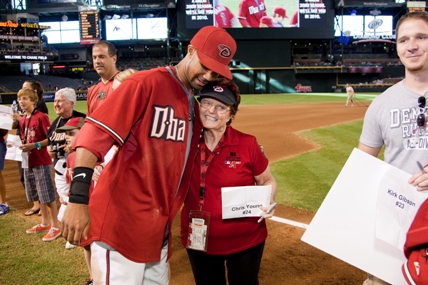
After the D-backs finish their game with the Los Angeles Dodgers on Sept. 26, the entire roster of players and coaches will greet fans on the third base line. Each meets with one fan individually, with a hug and a photo opportunity, and then gives away the shirt right off his back.


“Shirts Off Our D-backs is a great way to thank our fans for their support,” said D-backs President & CEO Derrick Hall. “We have the best fans in baseball, and we are constantly striving to find more ways to give back. It thrills me every season to see the excitement as our fans meet their favorite players on the field.”


The D-backs’ 12th annual Shirts Off Our D-backs event is presented by Panda Express and in addition to the chance to meet a D-backs player and get his jersey, fans will know they’ve given back to their community in the process.


Fans can purchase $5 raffle ticket packs, which include three raffle tickets, throughout the final weekend against the Dodgers on Sept. 24-26. Each ticket pack comes with an offer from Panda Express, and don’t worry if you don’t receive a jersey. Fans with non-winning raffle tickets will receive a discount offer from the Team Shop, a buy-one-get-one ticket offer for 2011 or a second chance to win a Chris Young jersey.


Furthermore, the D-backs have combined efforts with United Way in 2010 to help the community by taking advantage of this popular annual event. The D-backs will donate proceeds from Shirts Off Our D-backs to a United Way education program that focuses on impacting the education outcomes for students in the transition years, grades 5-12. Helios Education Foundation will be teaming up for education with the D-backs, donating $50,000 in matching funds to United Way.


“Positive change in education has to be driven by collaboration and effective community partnerships,” said Paul Luna, President and CEO of Helios Education Foundation. “That’s why we’re excited about our work with the Arizona Diamondbacks and the Shirts Off Our D-backs initiative.”


“Helios Education Foundation is dedicated to creating opportunities for individuals to succeed in postsecondary education, and that work begins by supporting initiatives that help create a college-going culture in our homes, neighborhoods and communities. Through this partnership, we’re elevating the conversation about preparing our students for success across the education continuum, from pre-kindergarten to postsecondary education. And, that truly is a home run for all of us.”